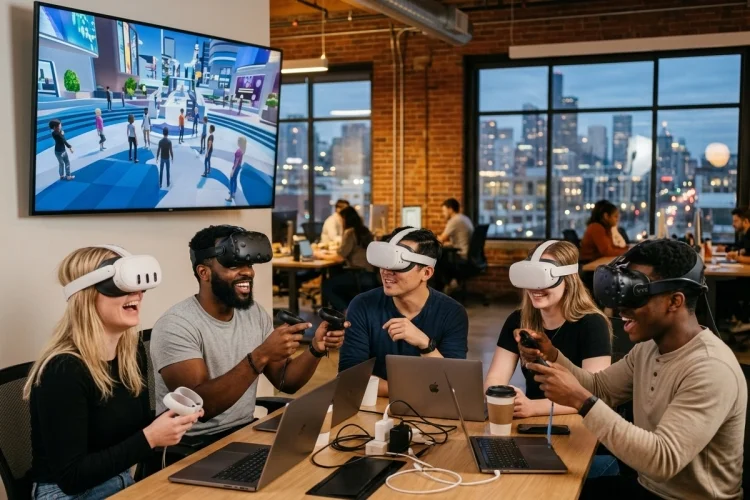
Digital experiences can have beautiful graphics, clever features, and polished interfaces, yet still feel strangely empty.
What often makes the difference is whether users sense that other people are genuinely “there” with them. That feeling is known as social presence.
Understanding How Social Presence Influences Engagement matters for social VR, multiplayer games, livestreams, virtual communities, collaborative platforms, and even interactive learning environments.
When users perceive others as real, responsive social partners rather than distant usernames, they tend to communicate differently, participate more actively, and become more emotionally invested in the experience.
What Social Presence Actually Means
Social presence is not simply the number of people visible on a screen. A platform can display hundreds of avatars and still feel socially lifeless.
At its core, social presence describes the degree to which another person feels psychologically available during mediated communication.
Researchers have developed several definitions and measurement approaches, but interpersonal connection, perceived immediacy, and awareness of other people remain central themes.
Think about the difference between entering an online room filled with silent profile icons and entering one where people respond naturally to what you say.
The second environment feels less like software and more like a shared social space.
That difference can dramatically change user behavior.
Why Human Connection Encourages Participation
People usually invest more effort when they believe their actions are being noticed by others.
In an interactive environment, even simple signs of acknowledgement can make participation feel meaningful.
A teammate answering a question, an avatar turning toward the speaker, or someone reacting to a shared event creates evidence that the user is not acting alone.
Research in collaborative virtual reality has found significant associations between indicators of social presence and active, constructive, and interactive forms of cognitive engagement. Open communication was particularly prominent during peer interaction.
That helps explain why highly social environments can encourage users to contribute rather than simply observe.
A conversation becomes more engaging when participants expect a response.
A collaborative challenge feels more important when teammates depend on each other.
The underlying technology matters, but the perceived human conection often determines whether interaction feels worth continuing.
Communication Cues Make Digital People Feel More Real
Social communication contains countless small signals.
Voice tone, pauses, facial expressions, gaze direction, gestures, timing, and body orientation all help us understand whether someone is paying attention.
Digital media removes some of these cues, so designers need to decide which ones to restore.
Richer Communication Is Not Always About Video
An experiment involving 133 university students compared video, audio, and text-chat communication during an online group task. Participants using chat reported lower social presence, peer rapport, motivation, and satisfaction than participants using video or audio.
That does not mean every platform needs cameras.
Audio alone can communicate timing, emotion, personality, and spontaneous reactions that text may struggle to reproduce.
In games or virtual worlds, animated avatars can provide another layer through gestures, head movement, or eye direction.
The goal is not maximum sensory information. It is enough meaningful communcation to help users understand that another person is actively present.
Responsiveness Turns Interaction Into Engagement
One of the fastest ways to destroy social presence is to make communication feel delayed or ignored.
Imagine telling a joke during a virtual event and receiving a reaction five seconds later. Technically, the message still arrived, but the social rhythm feels wrong.
Responsivness affects whether digital interaction feels conversational.
This applies beyond voice chat. Multiplayer animations, typing indicators, read receipts, avatar gaze, reactions, collaborative object movement, and live audience feedback can all signal that another human is responding in real time.
Immediate feedback creates a loop:
User Action → Social Response → Emotional Reward → Further Participation
When that loop works smoothly, users have a reason to keep interacting.
When responses feel random or disconnected, engagement can quickly become passive.
Social Presence Can Build Attachment and Return Behavior
Engagement is not only about what people do during one session.
It also includes whether they want to return.
Research involving metaverse users has explored relationships among time spent, social presence, attachment, engagement, and revisit intentions.
The findings indicated that social presence and attachment were associated with stronger intentions to revisit virtual environments.
This makes intuitive sense.
People rarely return to a digital community simply because the menu design was attractive. They return because relationships, conversations, shared experiences, or social expectations give the environment personal meaning.
A multiplayer game might initially attract someone through gameplay.
Months later, their strongest reason for logging in may be the group of friends they play with every evening.
The content created the first visit. Social connection created the habit.
Trust and Social Support Deepen Engagement
Social presence can also influence how comfortable people feel sharing experiences or requesting support.
A large survey involving 1,231 social VR users found that social presence and self-presence predicted perceived social support, which was positively associated with subjective well-being.
This does not mean every digital platform needs to become an emotional-support community.
It demonstrates something broader: when other users feel psychologically real, interactions can carry greater emotional weight.
Advice from an anonymous icon may feel disposable.
The same advice delivered by someone whose voice, behavior, and avatar have become familiar can feel much more personal.
That emotional investment often increases engagement because users begin treating relationships inside the platform as meaningful relationships rather than temporary interacton.
Too Much Social Presence Can Create Pressure
Social presence is powerful, but more is not automatically better.
A highly visible social environment can increase anxiety, performance pressure, or fear of judgement. Users may hesitate to explore when they feel continuously watched.
This is especially relevant for newcomers.
Entering an established virtual community where everyone appears socially connected can feel intimidating.
Designers can reduce that friction with private onboarding spaces, optional communication modes, smaller group experiences, and clear controls over visibility.
Social presence should create connection without eliminating personal space.
Some users want active conversation. Others prefer observing before participating.
Strong digital communities usually support both styles.
Design Social Presence Around Meaningful Moments
Adding avatars or voice chat does not automatically create social engagement.
Designers should identify the moments where awareness of another person genuinely improves the experience.
In a cooperative game, that might be coordinated movement and reactions during difficult challenges.
In livestreaming, it could be real-time acknowledgment between creator and audience. In collaborative learning, it could involve discussion, shared objects, and peer feedback.
The best question is not, “How can we add more social features?”
It is:
“When should users feel that another person is truly here with them?”
Once that moment is understood, technology can support it with appropriate communication cues, responsiveness, identity, and shared activity.
Understanding How Social Presence Influences Engagement reveals why successful interactive media often feels socially alive rather than merely technically impressive.
Human connection, responsive communication, trust, and meaningful shared activity can transform passive users into active participants.
When designing your next digital experience, focus less on adding social features everywhere and more on creating moments where users genuinely feel noticed, connected, and involved.