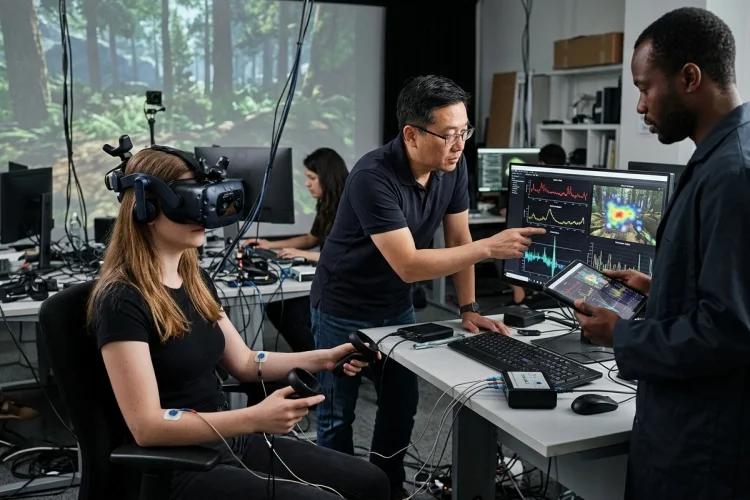
A virtual environment can look incredible and still feel strangely distant. Meanwhile, a visually simple experience can sometimes make users forget the room around them within minutes.
That difference is why measuring immersion purely through graphics quality, frame rate, or headset specifications rarely tells the whole story.
Advanced Presence Measurement focuses on the user’s actual experience of “being there.”
For developers working with virtual reality, mixed reality, immersive games, simulations, or interactive media, measuring presence can reveal why certain experiences feel convincing while others never quite pull users into the digital world.
Presence and Immersion Are Not Exactly the Same
The words presence and immersion are often used interchangeably, but researchers frequently separate them.
Immersion generally refers to characteristics of the technology, such as field of view, stereoscopic rendering, spatial audio, tracking accuracy, and interaction capabilities.
Presence describes the psychological experience of feeling located inside the mediated environment.
The Igroup Presence Questionnaire, or IPQ, explicitly distinguishes technological immersion from subjective presence. Its framework evaluates spatial presence, involvement, experienced realism, and an overall sense of “being there.”
That distinction matters because upgrading hardware does not automatically guarantee stronger presence.
A technically advanced headset running a poorly designed environment may produce weaker presence than a simpler system with believable interaction, responsive characters, and coherent spatial audio.
Measure More Than a Single Presence Score
A common mistake is reducing presence to one number.
A participant completes an immersive session, gives it an 8 out of 10, and the team concludes that presence is strong. The score may be useful, but it does not explain why the experience worked.
Advanced Presence Measurement benefits from treating presence as multidimensional.
The IPQ, for example, separates spatial presence from involvement and experienced realism.
The ITC-Sense of Presence Inventory was developed as a cross-media measure and includes dimensions such as sense of physical space, engagement, ecological validity, and negative effects.
These dimensions can reveal very different design problems.
A user might feel strongly located inside a virtual concert venue but remain emotionally disengaged. Another user could find an interactive documentary highly engaging while never feeling physically transported into its environment.
Those experiences should not receive the same diagnosis.
Combine Questionnaires With Contextual Questions
Post-experience questionnaires remain one of the easiest ways to measure subjective presence.
They are inexpensive, relatively quick, and easy to compare across prototypes. However, the questions should match the type of immersive media being evaluated.
A VR training simulation may need stronger emphasis on spatial presence and interaction realism. An immersive film may care more about engagement, narrative attention, and perceived environmental credibility.
A systematic review covering presence research found that the field uses numerous questionnaires derived from different theoretical definitions, making direct comparisons between studies more complicated than they first appear.
That means teams should avoid casually mixing different scales.
Choose one established framework, document how it is administered, and keep the procedure consistant between versions of the experience.
It is also useful to collect contextual information such as prior VR experience, session duration, device type, locomotion method, and whether participants experienced discomfort.
These variables can explain unexpected scores.
Look for Behavioral Evidence of Presence
Sometimes users reveal presence through behavior before they describe it in a questionnaire.
Imagine someone standing near a virtual cliff.
They know intellectually that the floor continues underneath them, yet they hesitate before stepping forward. Another participant may instinctively move aside when a virtual object travels toward their head.
These reactions provide behavioral clues.
Mel Slater’s work on presence distinguishes between place illusion, the feeling of being located in a virtual place, and plausibility, the feeling that events occurring there are really happening.
When these elements work together, people may respond realistically to virtual situations even while knowing they are simulated.
For product teams, behavioral measurement might include hesitation time, avoidance movement, interpersonal distance, head orientation, interaction frequency, or reactions to sudden environmental events.
The point is not to declare every physical reaction proof of presence. Instead, behavioral data can strengthen the interpretation of subjective reports.
Track Breaks in Presence
Presence does not need to remain constant throughout an experience.
Users may feel deeply absorbed for several minutes and then suddenly become aware of the headset because tracking fails, a controller loses connection, text becomes difficult to read, or an unexpected real-world sound interrupts them.
These moments are often described as breaks in presence.
Tracking them can be more actionable than asking whether the entire experience felt immersive.
If presence drops every time users open an inventory menu, the problem may be interface design. If it falls during locomotion, movement mechanics or visual comfort could be responsible.
Teams can record the approximate point where disruption occured and compare it with system telemetry.
Was there a frame-rate spike? Tracking loss? Audio interruption? Interaction failure?
That connection between subjective experience and technical performance turns presence measurment into a practical development tool rather than an abstract research exercise.
Evaluate Plausibility Alongside Visual Realism
Photorealism receives a lot of attention in immersive media, but believable behavior can matter just as much.
A beautifully rendered character who ignores the user may damage presence faster than a stylized character that responds naturally.
Slater’s place illusion and plausibility model highlights this distinction. Plausibility depends partly on whether events appear to relate convincingly to the participant and whether the scenario behaves according to reasonable expectations.
Suppose a user waves at a virtual host.
If the host looks toward them, responds, and adjusts the conversation, the environment feels reactive. If nothing happens, the illusion weakens.
Presence testing should therefore examine not only graphics but also interaction logic, environmental responses, character behavior, sound, timing, and consistency.
Compare Versions With Controlled Tests
Presence data becomes most valuable when teams can compare meaningful design changes.
Instead of asking whether Prototype B “feels better,” change one major variable and measure the difference.
One test might compare stereo audio against spatial audio. Another could compare controller locomotion with natural walking. A third might test whether responsive NPC gaze increases plausibility.
Keep session length, content, hardware, and participant conditions as similar as possible.
Then compare questionnaire results, behavioral responses, comfort ratings, and key interaction data.
You are not trying to find a magical universal presence score. You are trying to discover which design decisions consistently make the experience more convincing for your intended audience.
Advanced Presence Measurement works best when presence is treated as a layered experience rather than a single score.
Combine established questionnaires with behavioral observations, contextual data, plausibility testing, and breaks-in-presence analysis. The result is a clearer picture of what actually makes immersive media convincing.
Start measuring presence during prototype development, and use those insights to refine the experience before technical polish becomes expensive.