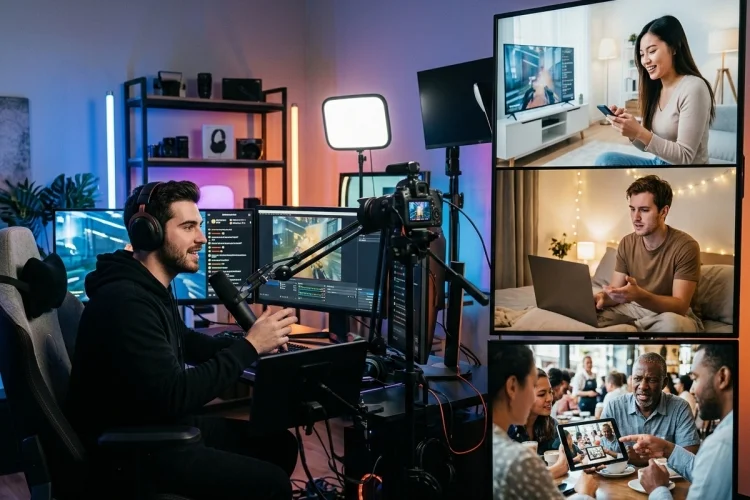
A live stream can have excellent video quality and still feel strangely disconnected.
The host asks a question, viewers answer immediately, yet those answers seem to arrive several seconds after the conversation has already moved on. For some viewers, the delay may be even longer.
Understanding How Latency Variance Changes Interaction Quality is important because average latency tells only part of the story. Interactive streaming depends on viewers experiencing events at roughly the same time.
When delay constantly shifts between devices or users, conversations, polls, reactions, competitions, and shared moments start losing their natural rhythm.
Latency and Latency Variance Are Different Problems
Latency is the time between something happening at the source and appearing on the viewer’s screen.
Amazon IVS describes this as end-to-end or glass-to-glass delay. Its low-latency channels can deliver streams below five seconds in suitable conditions, while real-time stages can operate below 300 milliseconds.
Observed delay can still vary with geography, network conditions, protocols, and components in the delivery chain.
Latency variance is the change in that delay over time or between viewers.
Imagine Viewer A consistently watching four seconds behind the host. Viewer B alternates between three, seven, and five seconds behind.
The average might look acceptable for both.
Yet Viewer B experiences a less predictable interaction because the relationship between what happens live and what appears on screen keeps moving.
Predictability can therefore matter nearly as much as raw speed.
Conversation Breaks When Feedback Arrives at the Wrong Moment
Human conversation depends heavily on timing.
A pause tells someone when to speak. A laugh confirms that a joke landed. A quick answer encourages the speaker to continue.
Live-stream interaction recreates some of that timing through chat, emojis, reactions, questions, and on-screen events.
Suppose a streamer asks, “Which level should we play next?”
Half the audience sees the question three seconds later. Another group sees it eight seconds later.
By the time the second group responds, the host may already be discussing the result.
Those users technically participated, but their participation feels less relevant.
This is why interactive platforms should think in terms of interaction latency, not video latency alone.
Video, chat delivery, reaction systems, and event-processing pipelines need to feel temporally connected.
When they drift apart, the experience becomes asynchronous even though everything is labeled “live.”
Audience Synchronization Matters for Shared Moments
Some live experiences depend more heavily on synchronization than others.
A lecture can tolerate several seconds of delay because most viewers are listening rather than actively shaping events.
A prediction game during a football match has a much smaller tolerance.
The same applies to watch parties.
If one viewer laughs five seconds before everyone else reaches the scene, group conversation becomes awkward. Spoilers can appear accidentally because the audience is effectively watching several different timelines.
Amazon notes that live-stream latency can vary between users because of geographic location, network type, speed, protocols, and delivery components.
That means platforms should monitor viewer-to-viewer skew in addition to broadcaster-to-viewer latency.
Two viewers each being five seconds behind the source is often easier to manage than one viewer being two seconds behind and another being twelve seconds behind.
Shared timing creates shared context.
Polls and Interactive Events Need Latency-Aware Windows
Polls, predictions, quizzes, auctions, and voting systems make latency variance especially visible.
Imagine a live trivia stream.
The host reveals a question and gives viewers ten seconds to answer.
A user watching seven seconds behind has effectively received only three seconds.
That is not simply a streaming-quality problem. It becomes a fairness problem.
Interactive systems can compensate by using server-timed events instead of relying entirely on what the viewer sees locally.
Another option is extending response windows according to known playback position.
For high-stakes interactions, the application can synchronize the interactive event with the viewer’s media timeline rather than a global wall-clock moment.
The correct approach depends on the product.
A casual emoji poll may tolerate imperfection. A competitive quiz with prizes probably requires much tighter timing.
Jitter Can Quietly Increase Playback Delay
Variation does not always originate from the streaming server.
Packets travelling across a network do not necessarily arrive at perfectly regular intervals. In real-time media, this variation is called jitter.
WebRTC exposes an interarrival jitter measurement through its statistics API. Higher jitter means packet arrival timing is becoming less predictable.
Players often compensate with a jitter buffer.
Instead of playing every packet immediately, the client holds media briefly so variations can be absorbed before playback.
MDN explains that a jitter buffer may hold samples or frames longer to produce smoother continuous playback. Rising jitter-buffer delay can indicate that the network is becoming less reliable or predictable.
This creates a classic trade-off.
More buffering improves stability.
More buffering also increases delay.
The viewer gets smoother video but moves farther behind the live moment.
That trade-off must be tuned according to how interactive the experience actually is.
Low Latency Can Become Fragile Without Enough Buffer
Reducing delay aggressively sounds ideal until the network changes.
A player sitting only one second behind the live edge has very little media stored ahead. A brief bandwidth slowdown can cause a stall.
A player six seconds behind has more protection.
Apple’s Low-Latency HLS design uses partial media segments so players can access pieces of content earlier rather than waiting for complete traditional segments.
Apple notes that these partial segments can be much shorter than regular media segments, enabling earlier delivery near the live edge.
But pushing closer to live still requires careful buffering.
The goal should not be “lowest latency at all costs.”
It should be lowest stable latency appropriate for the interaction.
A livestream shopping event may comfortably operate with a few seconds of delay.
A guest interview requiring natural back-and-forth communication may need real-time technology such as WebRTC.
Measure Variance, Not Just the Average
A dashboard showing “average latency: 3.8 seconds” can hide significant problems.
Teams should examine the distribution.
What is median latency?
What do viewers at the 95th percentile experience?
How much does latency change during one session?
How far apart are viewers watching the same event?
For WebRTC experiences, useful statistics can include network jitter, packet loss, freeze counts, and jitter-buffer delay. MDN’s WebRTC statistics model exposes several of these measures, including buffer delay and video freezes.
Product metrics should also connect technical data to participation.
Does chat activity decline when viewer delay increases?
Are late users less likely to vote?
Do viewers leave after repeated stalls?
A technical number becomes useful when it explains a behavioral outcome.
How Latency Variance Changes Interaction Quality is ultimately about keeping live audiences on the same conversational timeline.
Low average delay matters, but predictable playback, synchronized viewers, stable buffers, and latency-aware interactions matter just as much.
Measure variation across users and sessions, then design polls, chat, and reactions around real playback conditions rather than assuming everyone sees the same moment simultanously.